Anyone who knows me will know how passionate I am about our NHS. I appreciate that it has its shortcomings, but overall, I believe it is something to value, cherish and be proud of.
This week, however, once things started to unravel, it became an unstoppable tsunami of bureaucratic errors.
It all started on Monday, when I developed a new minor complication. It didn’t clear up on its own over the following 24 hours, so on Tuesday I contacted the lovely breast cancer nurses at the hospital for advice.
This was clearly not an emergency, just a minor annoyance that might need some medical intervention. As I suspected, though, it wasn’t something the hospital could deal with and I needed to speak to my GP.
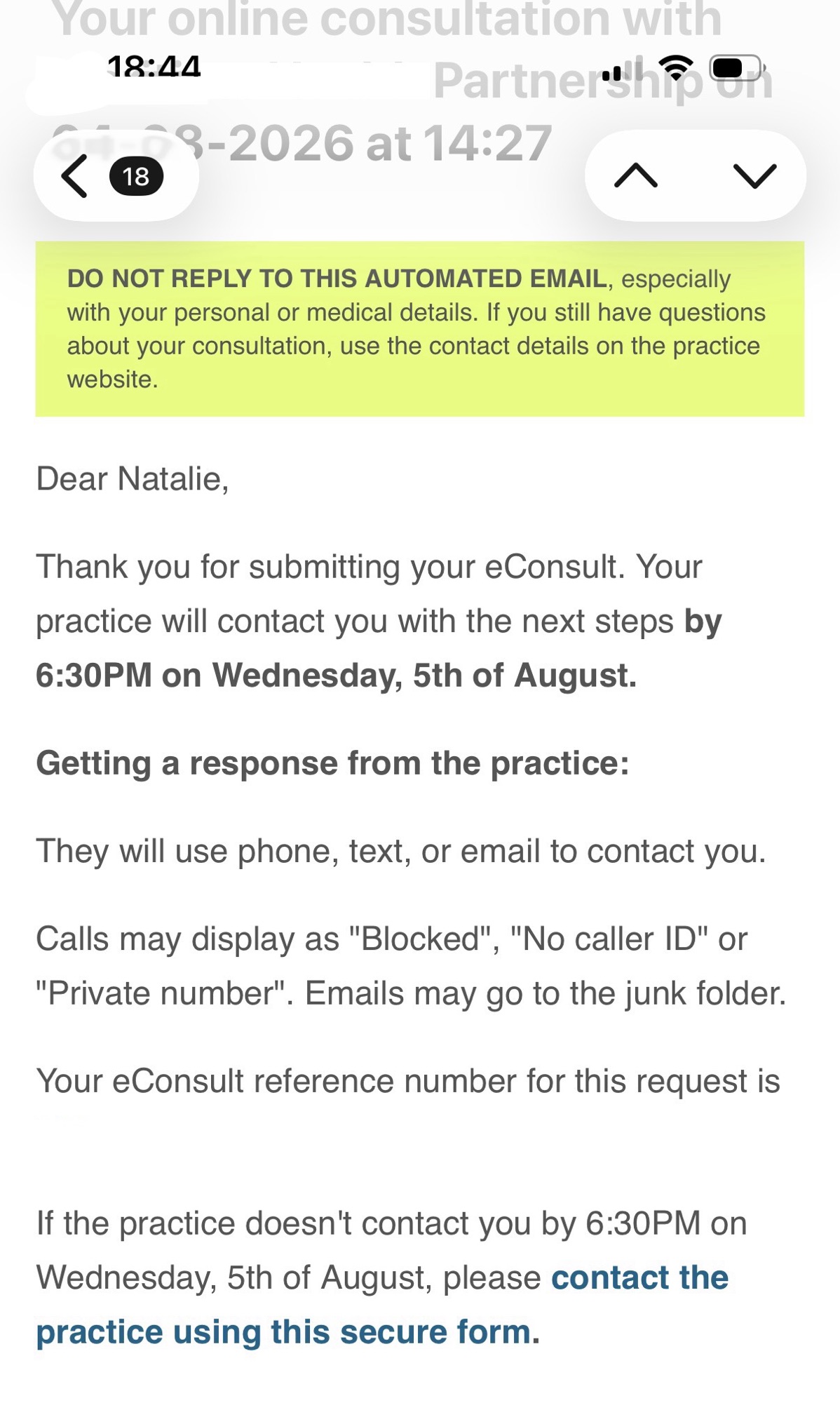
I dutifully logged onto the NHS app, completed several pages of an “eConsult” form, and pressed ‘Submit’. Moments later, I received an email confirming my submission, along with a reassuringly detailed explanation of what would happen next. The practice would contact me by 6:30pm on Wednesday and I might receive a phone call, text or email. I was even warned that calls might appear on my phone as “Blocked”, “No caller ID” or “Private number”, and that emails might find their way into my Junk folder.
Very thorough.
Wednesday came and went without any communication from the surgery.
I did, however, discover a couple of emails I’d been expecting from other sources lurking in my Junk folder. Perhaps the NHS was onto something and this was a timely reminder that I should check it more often.
Late on Wednesday, I submitted a reminder to the practice, as instructed in their original email.
On Thursday morning, I finally got a call inviting me to pop into the surgery at 4pm for a consultation.
Excellent. Progress.
In the meantime, I’d realised that I was also running out of some of the medication I’d been prescribed by the hospital, so I made another call to the breast cancer nurses for advice. I was told that I would need to ask my GP to prescribe the medication.
That’s handy, I thought. I’m seeing the GP later today. I can ask for them then.
I arrived at the surgery a good twenty minutes before my appointment, only to discover that a “4pm appointment” was apparently a rather flexible concept. I was finally called through at 4:50pm.
Still, at least I was there.
The doctor quickly sorted out my latest minor issue, and I asked about the repeat prescription.
“I’m sorry, we can’t help you, because we don’t have any information about your condition – not even a diagnosis on file.”
Ah.
Fortunately, I had brought the various medications with me, still in their original packaging, and was able to show him that they had been prescribed and dispensed by the hospital only about a month earlier.
But I couldn’t quite understand what was happening.
How could my GP surgery have no information about my breast cancer diagnosis?
And, more importantly, how on earth was I supposed to get the medication I needed?
The doctor then informed me that the medications would have to be added to my record by the Reception Team, then reviewed by the Prescription Team, who were now based in a different building in the next town – and finished at 4pm.
The clock was now edging towards 5pm and the doctor clearly wanted to be somewhere else. He said abruptly, “I’m sorry, I’ve spent enough time on you already and you will have to leave.”
I’m not quite sure what happened next.
I remember calmly but firmly saying, “No, I’m not leaving until this is resolved” just as a member of the clerical team arrived in the surgery. Perhaps the doctor had pressed an alarm button, but I’m not quite sure.
As I started explaining the situation to her, I heard the doctor sigh audibly and say that he would sort it out now and authorise the prescription.
Moments later, I heard him say, “That’s done now, and they’re ready to pick up from the pharmacy on the High Street.”
With that, he got up from his desk and left the room.
By now, I was beginning to feel a little tearful around the edges, so I went back to the main reception with the staff member.
I remember her saying, “Please don’t get upset. A member of the Prescription Team is here in the building, and I’ll go and have a word with him.”
I watched her step into the administration office next door and speak to a young man. A few moments later she returned.
“Don’t worry, it’s sorted now.”
I breathed out.
And, remembering my grandmother’s wise words to always be polite and grateful to everyone who tries to help, I thanked her and the receptionist for their kindness.
The normally rather dour receptionist replied super-brightly, “That’s what we’re here for.”
And, for that moment at least, I was very grateful that they were.
Shortly after 8am the following morning, I received a call from the GP surgery asking if I could come in at 2:30pm. I assumed this was a follow-up to yesterday’s fiasco.
Later that morning, my ever-patient husband collected three boxes of meds from the pharmacy, only to be told that he would have to return the following day for one outstanding item.
I checked his haul when he got home and realised that a vital pain relief drug was missing from the prescription. I assumed that could be sorted during my visit to the surgery that afternoon. After all, I could take along a copy of my diagnosis letter and any other relevant paperwork.
Not without some trepidation, I arrived ten minutes before the appointed time and sat down in the waiting room.
While I was waiting, the lovely admin lady who had been so helpful the previous day came over to check that I was OK. She recognised me – not difficult, admittedly, with my chemo cap and face mask!
I showed her my diagnosis letter and she explained that there were delays “in getting these on the system”.
Three months of delays, apparently.
I was then seen by a helpful doctor – importantly, not a locum – and it quickly became clear that there had been yet another mix-up. It seemed that this second appointment was either in response to my original request or to my follow-up reminder. To be honest, by this point I was beginning to lose track. But perhaps it was a fortunate mix-up, because it gave me an opportunity to explain what had happened in that very same room less than 24 hours earlier.
This doctor was very sympathetic and agreed to prescribe the missing painkillers for now. We also agreed that I would go back to my oncologist in the next couple of weeks and ask them to send the GP practice a letter making it clear that the GP should prescribe the medication and – crucially – for which drugs – if and when required.
Progress! 🙌
The following day, my husband collected the final batch of drugs from the pharmacy, including six boxes of the medication that had been missing the previous day.
Six boxes 😂
That should be enough for about six months – clearly, yet another bureaucratic error.
But I’m not going to return them. I fought hard for those! 🎁
And perhaps that is one of the things I’m learning about this dreadful disease.
Just when I get to the point of thinking, “That’s it, I’ve had enough now…🥺”, something small happens and suddenly everything feels manageable again.
You really do have to take the wins where you find them…

Leave a comment